
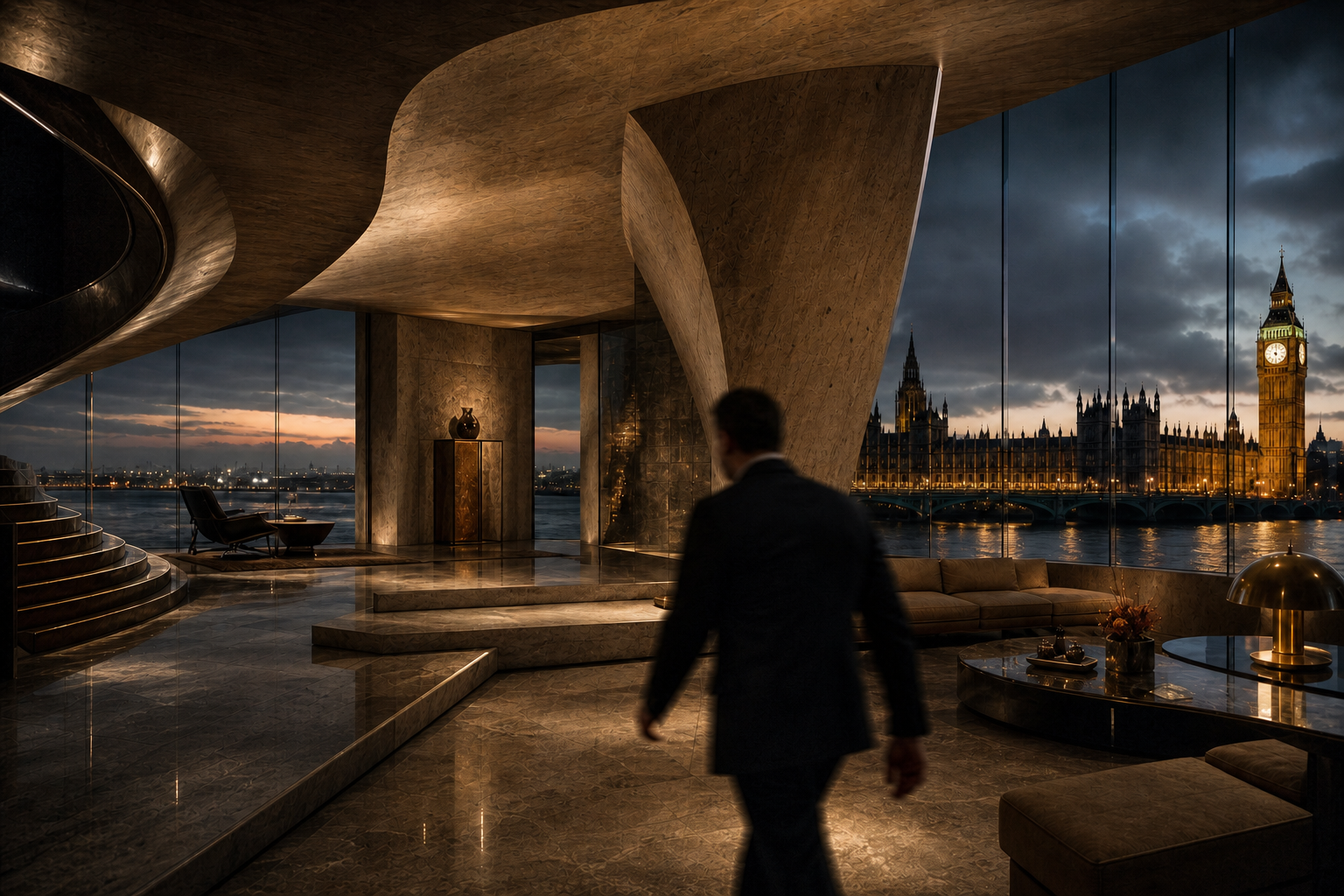
Forget the car. I want to see the house.
Mix old and new
Dr No’s apartment, 1962
Warm up modernism
Goldfinger’s rumpus room, 1964
Let the architecture work
John Lautner's The Elrod House, 1971
The idea
A new James Bond is coming. Naturally, everyone wants to know who will wear the dinner jacket. I have another question. Where is he going to live?
Long before warm minimalism, quiet luxury and indoor-outdoor living had names, his best rooms were already doing it. Timber against steel. Stone beside glass. One very good chair with plenty of room around it.
Not every Bond interior has aged so well. We can probably leave the volcanoes, control rooms and furniture that disappears into the floor where they are. But the best ones still look startlingly current.
And there is a reason.
Production designer Ken Adam didn’t decorate rooms so much. He invented worlds. Across seven Bond films, beginning with Dr No in 1962, he created a visual language that would become inseparable from Bond: enormous spaces, strong geometry, dramatic light and materials allowed to behave like themselves.
Timber looked like timber. Stone looked like stone. Metal gleamed. And rather than filling a room with things, Adam often gave one idea enough scale to dominate it. It is a surprisingly useful interiors lesson sixty years later.
The details
Mix old and new
Dr No’s apartment
Dr No | 1962
The first Bond interior may also contain one of the easiest ideas worth replicating. Don’t match everything.
Modern furniture sits against rough stone, alongside antiques and artwork. The room has modern lines without becoming a period-perfect exercise in modernism. That tension is what makes it interesting.
A genuinely good room rarely looks as though everything was bought together. Something old makes something new look newer. A rough surface makes a polished one feel more polished. Straight lines become more interesting beside irregular ones.
Today we call it layering. Dr No was doing it in 1962.
Steal this
Mix periods, not furniture sets. Stone. Art. Something old. Something modern. Then stop.
Warm up modernism
Goldfinger’s rumpus room
Goldfinger | 1964
Yes, the billiard table becomes a control panel. Ignore that.
Look instead at what happens when you put one unapologetically modern object into a room that is otherwise drowning in timber.
The fireplace shouldn't work. It's enormous, shiny and about as subtle as Goldfinger himself. Which is precisely why it does.
Take it away and the room starts heading towards ski lodge. Take away the timber and things get considerably colder.
Together, each fixes the other.
That is the bit worth stealing.
Steal this
Don't make every material agree. If the room is warm, give it something sharp. If it's hard, add something tactile. Too much harmony makes a room terribly flat.
Let the architecture DO THE work
The Elrod House
Elrod House, Palm Springs | Diamonds Are Forever | 1971
And then Bond walked into the Elrod House. John Lautner designed it for the interior designer Arthur Elrod in the late 1960s, and more than half a century later it still looks astonishing.
The clever bit is that the interior never fights the building. The furniture follows the curves. The rug responds to the room. Glass disappears to connect the living space with the pool and desert beyond.
Even the landscape gets invited inside.
Nothing is trying to distract you from the architecture because nothing needs to.
That is the lesson. Sometimes the thing making a room difficult is actually the thing that could make it brilliant. The odd window. The curve. The fireplace. The stone wall. The view.
Work with it.
Steal this
Look at the room before you decorate it. Something may already be telling you what the rest of it needs to do.
Why it works
Look again at these rooms and surprisingly little feels fashionable. That is probably why they have lasted.
It is not really about a particular sofa or the colour everyone happens to be painting their walls this year. It is about material.
The grain of timber. The irregularity of stone. The weight of concrete. The reflection of metal. Glass disappearing between inside and out.
And then there is the furniture. Low. Sculptural. Well proportioned. Given enough space to actually be seen.
For rooms with this much drama, there is remarkably little fuss.
That may be the real red thread.
Restraint.
And what about the next Bond?
This is where things get interesting. Amazon MGM says the search for the new Bond is under way. Denis Villeneuve is directing, Steven Knight is writing, and Amy Pascal and David Heyman are producing.
If Villeneuve’s previous films tell us anything, he understands the power of a room. Arrival. Blade Runner 2049. Dune. Scale. Shadow. Texture. Silence. They tell you something about the person, which makes the prospect of a Villeneuve Bond particularly interesting.
Our guess? Less polished penthouse. More stone, concrete and timber. A spectacular piece of glass. One excellent chair. And considerably less on the walls.
In other words, rather close to what Bond was doing sixty years ago.
The verdict
Bond’s best interiors seem to have lasted because they were never really about luxury. They were about confidence.
Using real materials rather than imitation. Choosing one strong shape. Mixing old with new . Buying fewer, better pieces.
The identity of the next Bond may still be under wraps. His house? Concrete, surely.
Get the look
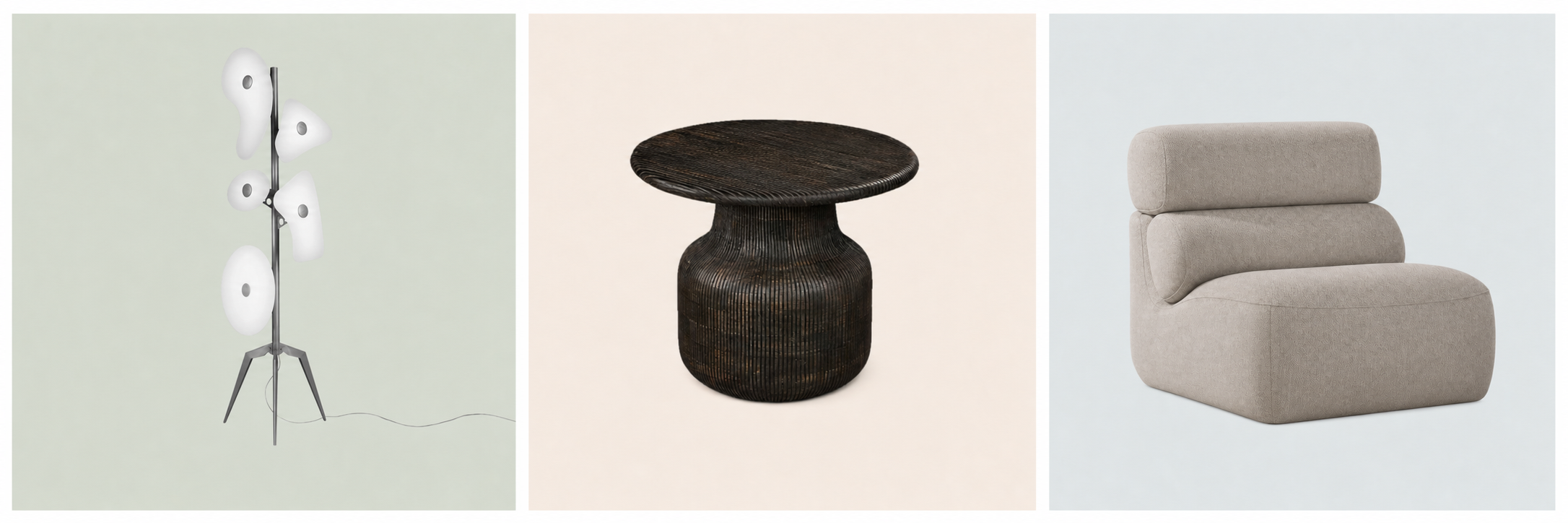
Want the look without the secret underground lair? Stone, timber, linen, sculptural lighting and a few very good shapes, inspired by the rooms that got it right.
SHOP THE SECRET AGENT EDIT →WHAT TO LEAVE OUT
No tiny furniture dotted around filling gaps. No desperate styling of every surface. No purposefully matching range. And definitely no ejector seat.
LIKE THIS?
Get The Edit in your inbox
Questions
When will the new James Bond be announced?
Producer Amy Pascal has said the end of 2026 is a good bet. Filming is expected to begin in 2027, with the film targeting a 2028 release.
Who is directing the next Bond film?
Denis Villeneuve, the director of Arrival, Blade Runner 2049 and Dune. Steven Knight, who created Peaky Blinders, is writing the script.
Who designed the classic Bond sets?
Ken Adam designed the sets for seven Bond films, from Dr No (1962) to Moonraker (1979). His work defined the look of the series.
Which house was used in Diamonds Are Forever?
The Elrod House in Palm Springs, designed by John Lautner for the interior designer Arthur Elrod. In the film, it plays the home of the billionaire Willard Whyte, and Bond ends a fight in its pool.