


Piet Oudolf, decoded: the six details I keep seeing in his gardens
Everyone remembers the mauve. Almost none of the garden is mauve.I looked across seven of Piet...
Everyone remembers the hedges. Almost nothing in the garden is in flower.
I looked across seven Wirtz International gardens and measured the colour in their summer photographs. Pink, red, purple and blue never take more than 0.2% of the picture. The rest is green, stone and still water.
Wirtz International is a family firm. Jacques Wirtz set up as a garden designer in Schoten, near Antwerp, in 1950. In 1990 the firm won the competition to remodel the Tuileries in Paris, jointly with Louis Benech and Pascal Cribier, and Wirtz took the Jardins du Carrousel, beside the Louvre. His sons Martin and Peter run the practice now; Jacques stayed closely involved until his death in 2018. Their gardens are built like buildings: walls, ceilings, corridors and rooms, all of them alive.
Rather than try to cover everything, I picked seven of their gardens: Les Jardins du Carrousel in Paris, Alnwick Garden in Northumberland, private gardens in Bruges, Knokke and New York State, the 7even Tuinen courtyards in Leuven and the Hufkens gallery garden in Brussels. Then I measured the colour in their summer photographs.
The secret isn’t the planting. It’s the frame.
This is my decode of their work from the outside looking in. You may well see their gardens differently.
Five details, each with what I'd do at home. Tap one to open it.
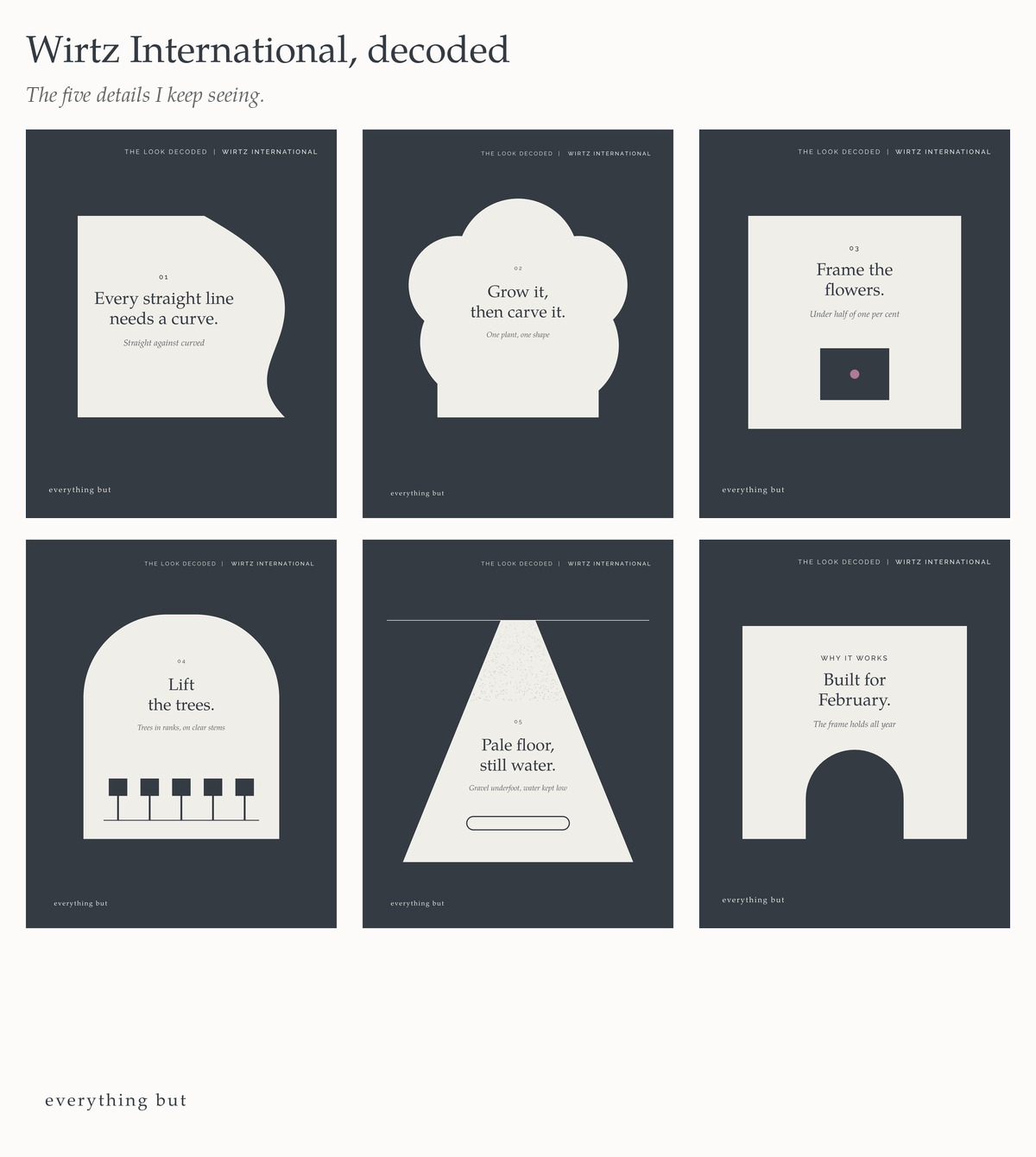
Every garden sets a ruler-straight line beside a soft one. A rectangular pond against serpentine box in Bruges, zigzag pools between ribbons of grass in Leuven, a straight stone rim against a curving rill at Alnwick. In Paris the yew hedges run dead straight from the Arc du Carrousel, then are clipped round on top: straight from above, soft from the side.
At home
Keep one edge dead straight, a path or the lawn, and let one clipped curve sit against it.
This is the one I’d start with. One straight edge and one curve of clipped green beside it, and a garden suddenly looks designed.

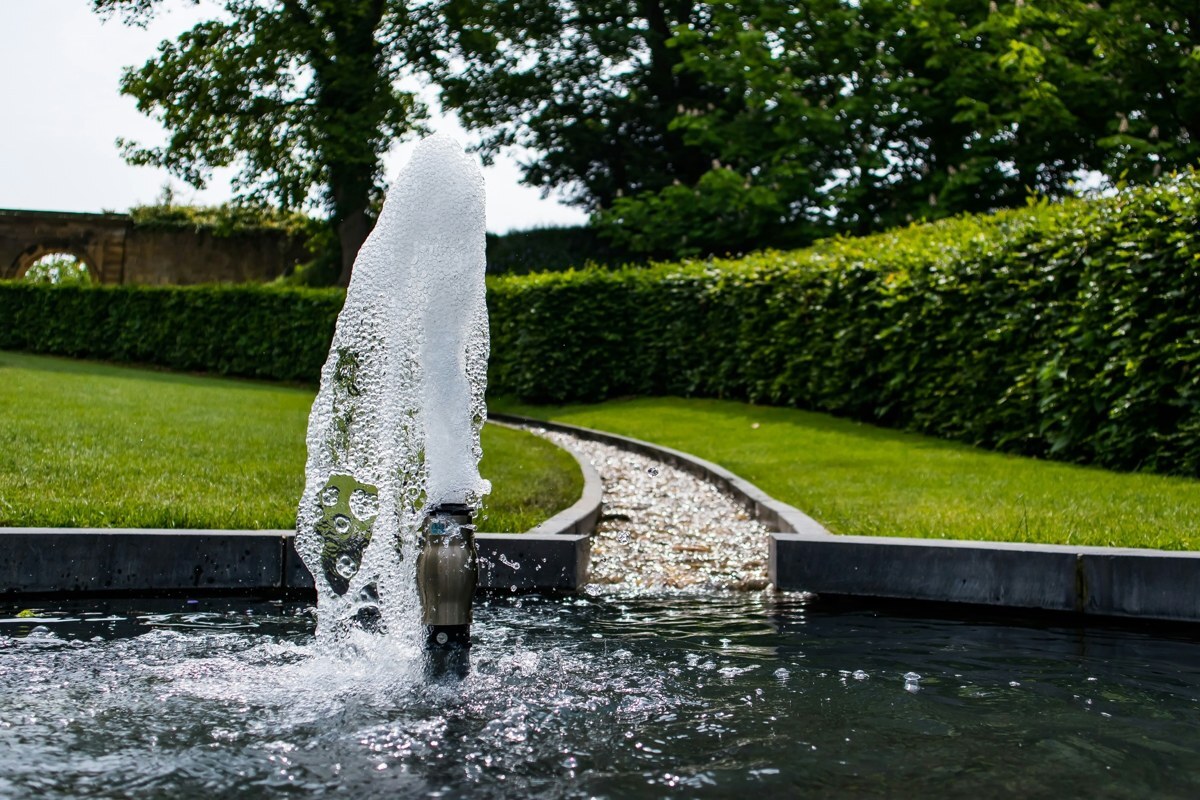
Alnwick Garden, Northumberland. Photograph: Michael Hutchinson on Unsplash.
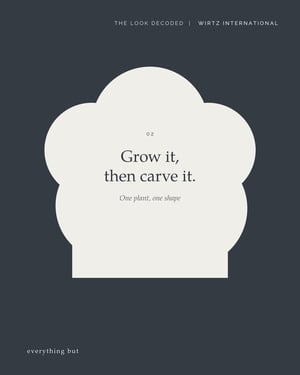
One plant, massed until it stops reading as a plant and starts reading as an object. Usually that means clipping: yew walls in Paris, waves of box in Bruges, hornbeam tunnels at Alnwick. But Hufkens has no clipping at all. There, mondo grass is planted thick in rounded beds and does the same job; in New York it is a dune of miscanthus.
At home
One plant, repeated: three clipped Ilex crenata balls along a path, or a short hedge cut into a wave.
Flowers only ever appear inside a clipped edge, and five of the seven gardens have none at all. Even Knokke, which the firm calls ‘an intensely flowering garden’, keeps its borders behind box.
Then I measured the photographs. Pink, red, purple and blue never take more than 0.2% of a summer picture; in Knokke it’s under 0.1%. For comparison, Piet Oudolf’s mauve came to about 1.5%. Here green does the work, filling between a third and two thirds of every picture.
At home
Keep flowers to one bed, framed by a low hedge, and let everything else be green.

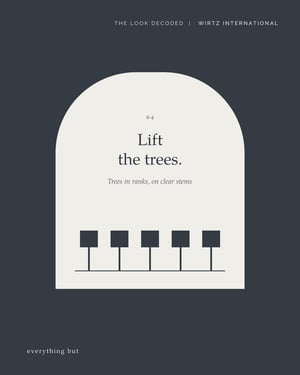
The trees stand in rows, grids and groves, nearly always on clear stems: pleached limes over gravel in Paris, forty pagoda trees down the New York drive, a grid over the flower beds at Alnwick, four ginkgos at Hufkens. Lifting the canopy gives the garden a ceiling and keeps the view open underneath. On the Leuven roof, where the soil is shallow, narrow katsura stand in raised planters instead.
At home
Three clear-stemmed trees in a line, or one either side of a path.
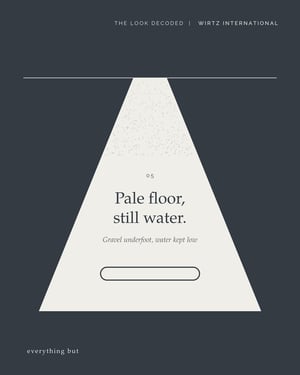
Gravel, sand or crushed dolomite underfoot in five of the seven, which lightens everything and sets off the dark green. Water sits low, with crisp rims, and mostly works as a mirror. Where there is a jet, as at Alnwick, it rises from a still pool rather than a sculpted fountain.
At home
A pale gravel path and a shallow, dark bowl of water, filled to the brim.
I looked for the same five details across all seven gardens. The first four appeared in every one. The fifth is really two: a pale floor in five gardens (Bruges and Leuven are paved or lawned) and still water in five (Knokke and Hufkens have none).
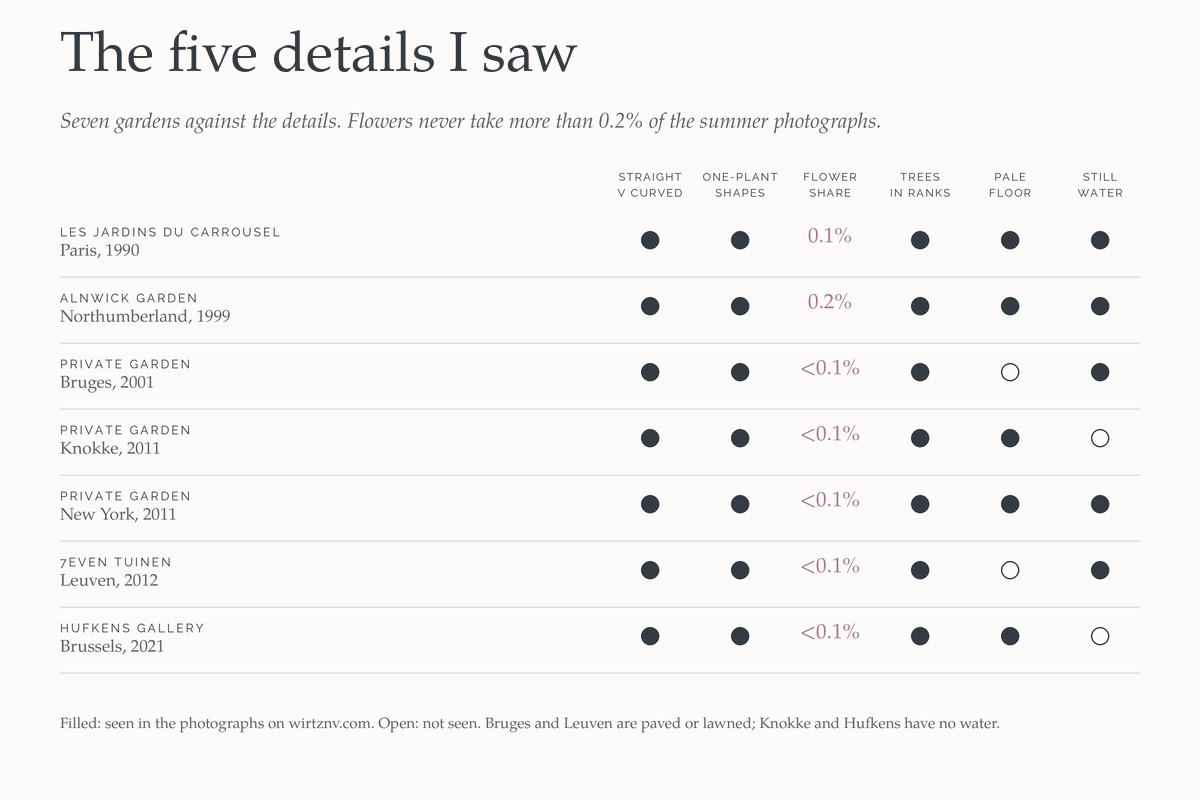
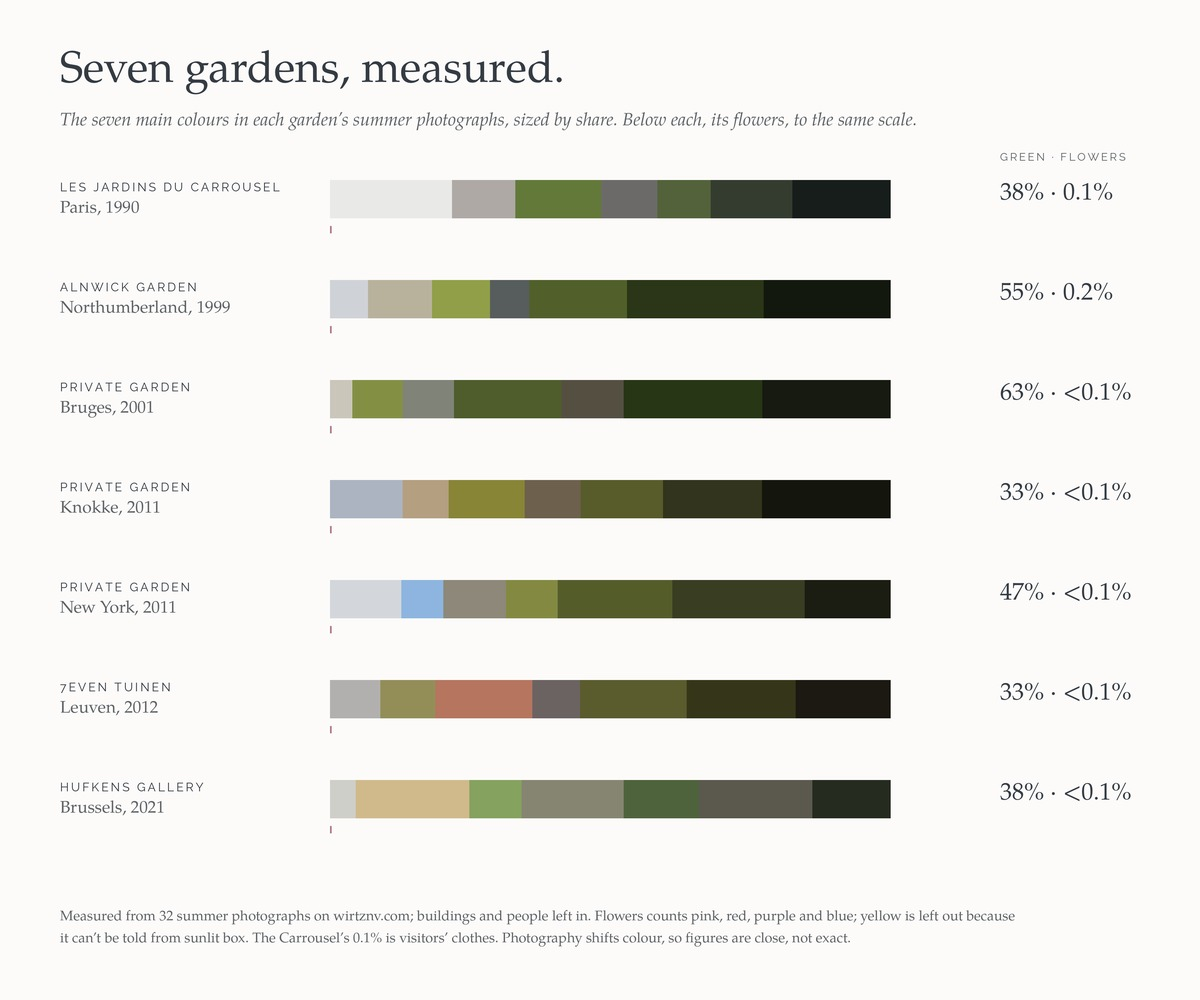
The gardens: Les Jardins du Carrousel, Paris (public roof garden, 1990), Alnwick Garden, Northumberland (castle garden, from 1999), a private town garden in Bruges (2001), a private town garden in Knokke (2011), a private estate in New York State (from 2011), the 7even Tuinen courtyards, Leuven (mixed-use, 2012) and the Hufkens gallery sculpture garden, Brussels (redesigned 2021).
How I did this I worked from the garden photographs and details on wirtznv.com. For each garden I logged the details and named plants, and measured the colours in the summer photographs, because autumn and winter shots make the colour too muddy. The percentages describe the photographs, not the planting itself: light, season and the choice of picture all affect them. Yellow is left out, because in a photograph it can’t be told apart from sunlit box.
Why it works
Every garden is built for February.
Almost all of it is evergreen, stone or gravel, so the garden barely changes shape through the year. Where leaves do fall, they’re chosen for it: ginkgos at Hufkens and katsura at Leuven, picked for their autumn gold.
Wall-to-wall lawn: the RHS says a tightly clipped lawn isn’t particularly wildlife-friendly, so swap some for a mass of one ornamental grass, as Wirtz does in New York. New box: I’d avoid planting it, given box blight and box tree caterpillar. And symmetry in a small garden: Wirtz only mirrors things at the scale of the Carrousel or Alnwick.
Yes. These gardens feel robust and imposing, and they look as good in February as in July. That matters in a British garden, where winter is long and grey.
The catch is the shears. A yew hedge usually wants cutting twice a year and box two or three times, and a clipped shape only looks deliberate if it stays sharp. Hornbeam and beech, at one cut a year, are the kinder choice.
If you’re new to this look, start with the first detail: one straight edge, one curve of clipped green beside it. You don’t need a grand garden or an army of gardeners. You need a strong shape, and the discipline to keep it.
My Edit, inspired by Wirtz International
My picks to try it at home.
My own picks, inspired by their gardens. Not affiliated with or endorsed by Wirtz International.
SHOP MY EDIT →LIKE THIS?
Interiors, gardens, useful ideas and things I’d genuinely want at home. The Edit lands every other Thursday.
Clip what you already have. The famous cloud hedges in the Wirtz family’s own garden began as old, gappy box that Jacques Wirtz cut back to healthy wood rather than replace. For new hedging, buy bare-root whips between November and March, when they cost a fraction of potted plants, and let them grow into the shape. One straight edge and a pale gravel path do the rest.
Mostly evergreens and trees that take the shears: yew, box, beech and hornbeam, Ilex crenata, pleached limes and clear-stemmed oaks. For softness, single grasses in big masses, such as miscanthus, and mondo grass as a carpet. Ginkgo and katsura bring the autumn colour.
Yes. Knokke is 200m²: one curving gravel path with a box hedge either side, a clipped tree on a clear stem and a glasshouse at the end. Skip the symmetry and put everything into one strong shape.
Choose the hedge for the ground. The RHS rates hornbeam and yew H7, hardy in the coldest winters. Hornbeam copes with heavy, damp clay better than beech; yew needs soil that drains. On truly wet ground, sort the drainage first. And buy from a local nursery rather than a national garden centre. In my experience gardening in an exposed spot in Scotland, plants grown in milder places, such as the Netherlands or the Channel Islands, struggled; stock raised nearby is already used to your weather, and you get local advice with it.
Yew, Ilex crenata, or no clipping at all: Wirtz uses all three. Box blight is at its worst in wet weather, so in the west and north I wouldn’t plant new box. For upkeep, the RHS suggests one cut a year for beech and hornbeam and two for yew, though it depends on how crisp you want the shape.
The hedges are: thick yew, beech and hornbeam give birds cover all year. The lawn is the weak point. Leave a strip to grow long, or swap some for a mass of grasses, and check for nesting birds before any hedge cut, usually March to August.
Alnwick Garden in Northumberland, where the firm designed the Grand Cascade and the gardens around it, is open to visitors. In Paris, Les Jardins du Carrousel sit between the Louvre and the Tuileries and are free to walk through. The firm’s own site, wirtznv.com, shows many more of its projects.
Spotted a detail I’ve missed, or think I’ve got Wirtz wrong? Tell me on Instagram @everythingbut.theedit.
Garden details from wirtznv.com. Alnwick photograph by Michael Hutchinson on Unsplash. Illustrations by Everything But.
AD | This article links to an Edit with affiliate links. I may earn a commission if you buy through them, at no extra cost to you.
Everyone remembers the mauve. Almost none of the garden is mauve.I looked across seven of Piet...

Dark, theatrical and impossibly inviting. Dimore Studio makes rooms that feel as though something...

A curve against a grid. Stone beside metal. A 2019 bench in a 1930s Georgian bedroom.